Me Too?

I appreciate the perspective that I have on sexual harassment, not because I understand it, but because I am making progress in understanding it.

Back when I was working at the banks, we had a training program that they would send us out to Toronto for. By the third trip, our cohort had gotten to know each other and one night we were on the hotel rooftop having drinks. A bunch of us were standing in a circle and one of the ladies decided she would show some interest. She walked over to me, started whispering things in my ear, then started rubbing my chest, then her hand went in the shirt, then down the pants.. all while I kept up a conversation with the others in that circle. I was obviously getting a lot of looks, but I kept pulling her hand out my clothes, politely told her to settle down, and laughed it off. It took about 20 minutes, but she eventually moved on and took someone else back to her room.

This was 5 years ago and I want to share what I’ve learned. It was only recently that my experience occurred to me as an example of sexual assault because it didn’t feel like it.. and I think I know why.

Part of it is that I’m quicker to compassion than I am to fear or hurt. She had a husband and kids at home, but she was on a work trip, drunk, tying to bed a guy half her age in front of a small crowd of coworkers.. I knew she was probably going through a rough patch so I tried to handle the situation with dignity. I wanted her to be better off than when we met.

I genuinely think we could all use a little more compassion in our lives, but it’s important to understand that it was easy for me to arrive at compassion because I never lost power or control of that situation. I was twice her size. Even if she were twice my size, I wouldn’t be concerned that she could force herself on me. In my mind, I was safe from what she was trying to do, and it let me act with compassion.

Most women aren’t twice the size of the men in question. All that safety that I felt likely wouldn’t exist for a woman in that same situation. For many, I’d wager that safety becomes fear. As we continue to discover/understand what gender equality really means… physical stature and the physical safety that comes with it is still a very real inequality.

That doesn’t mean that we should feel bad for being men, but it is a reminder that as men, we need to step up.  If you have the power to harm, you probably also have the power to protect.  Imagine if instead of hearing about a high profile sexual harassment case once a week, we heard about how the men around that person stepped up and shut it down?  That’s a future I’m willing to help create.

Win the Next Presidential Election With This One Weird Trick

I was tempted to throw in the /s but it’s true.  Seriously.

It wasn’t the republican right that elected Trump.  It wasn’t the democratic left that let Hillary down either.  It was the American people who made themselves heard.  Trump was elected as a giant fuck-you to how America governs – justifiably so.

It was a fuck-you to career politicians with fake smiles and fake laughs.

It was a fuck-you to wall street influencing monetary policy.

It was a fuck-you to the oversensitive and irrational alt-left.

It was a fuck-you to partisan politics and the inability of politicians to get anything done.

It was a fuck-you to the wealthy elite.

And perhaps most importantly, it was a fuck you to a lack of honesty and transparency between a government and the people it serves.

Trump may just be the best thing to happen to American politics in generations, in the same way that a bull is great for a china shop.  Bull wrecks china shop, owner realizes nobody buys china anymore and uses the insurance money to open a dispensary.  I think a lot of the people who voted for him already knew this, but if there was any doubt… he’s worse than a career politician, he’s the wealthy elite’s racist grandpa.  One of the first things he did was cozy up to wall street.  He’s just as irrational and oversensitive as the alt-left.  With republican control over the senate and house, he still can’t get anything passed. Bipartisanship is worse than ever.  Finally, and most importantly, Trump has probably solidified himself as the most dishonest politician in American history.  For anybody looking at this objectively, he’s the one you send in to undermine any remaining confidence in the American establishment.

So by the time the American people are ready to elect their next president, what are they going to be looking for?  The same thing we’ve always wanted…


Honesty and Transparency.


Seriously.  That’s it.  We’re just going to want it that much more after all this nonsense.  Run a campaign under the premise of releasing every confidential government file ever held.  Moon landing?  Release it all.  JFK?  Release it all.  9/11?  Release it all.  Area 51?  Release it all.  Every god damn piece of information that the government has – make it readily available to the public.  Maybe it all amounts to very little, but at least the public would regain their confidence in their government.  Or maybe we find out that the government hasn’t been as honest with us as we would’ve liked and we have an opportunity to rebuild that trust with a proper foundation.

Electing someone we don’t know to run a system we don’t understand isn’t exactly the best example of democracy but it does remind us how important honesty and transparency is between a government and its people.  Without good information, we can’t make good decisions and if we aren’t equipped with the information necessary to elect good leaders, where exactly does that leave us?  And yet honesty seems more scarce in politics than in any other profession.  Maybe this is what happens to lawyers when they don’t have to worry about perjury anymore.

We need to move beyond this idea that being uninformed makes us safer.  We need to move beyond this notion of the government taking measures to make us ‘feel’ safer at the expense of being less informed.  We need the government to stop treating us like kids and start treating us like equals and that starts with telling us WTF is actually going on.

I’m putting some brain power towards figuring out how to build an honest democracy that just doesn’t just hold itself accountable to the public, but also engages the collective thoughts and wisdom of its people on a regular basis.  I’m making progress.. might be ready in time for Mars.


A Quick Fix to Wealth Inequality?

I was having a chat with a friend yesterday about the incoming Canadian tax reform and he managed to inspire what I think is a rather interesting idea.

When it comes to modern finance, it’s a mess.  For the last few years, I’ve been trying to figure out a system of finance to account for the deflationary nature of technology and best practices while increasing productivity.  I think I’m close but it requires a complete overhaul of the system, and well as a cultural paradigm shift.  I’ll be patient.  Until then, I thought I’d mention an idea which works within the current system: Adjusting the local minimum wage to reflect the local cost of living.

If you’re working 40 hours a week, you should be able to earn a living.  That’s not to say that we should all be making the same, that’s to say that the floor should be set at what it costs to lead of modest lifestyle in that area.

Consider this, if someone is working 40 hours a week and living in poverty, they’re likely relying on social assistance programs.  Those social assistance programs are ultimately tax-payer funded.  That tax burden falls primarily on those who aren’t in poverty.  When someone grows up in a low-income neighborhood, falls in with the wrong crowd and ends up in prison, it’s the tax payers who pay for that too.  No matter how we look at it, we’re all in this together.  We either keep picking up the tab, or make an investment in the future.

For starters, imagine the impact this would have on the country’s collective anxiety – Knowing that if you work full time, you’ll be alright.  Now imagine the positive cultural impact of an entire generation of kids growing up with parents who aren’t barely getting by.  Now think about the reduction of people needing social assistance programs and the reduced government spending.  Now think about the reduced taxes for all tax brackets.  I guess we would call that trickle-up economics?  Just like trickle-down economics except rather than starting with helping those with the most and letting the residual benefits trickle down to those with the least, we start by helping those who need it the most and letting those residual benefits trickle up to those who need it the least.

The definitive test that trickle-up is better than trickle-down?  Trickle-up helps more people.

That all sounds pretty fantastic for people who are struggling to get by but that’s a rather large stone to toss in the water and it’s important to understand how this will affect everyone else in the pond, especially employers.

First off, businesses that haven’t embraced automation but probably should will likely need to.  The jobs which require the least amount of skill are often the ones which are easiest to automate so businesses will no longer need to rely on cheap labor to sustain their operations.  Fast food is already testing out automated ordering systems and burger flipping robots.

As the automation sector booms, the robotics and AI industries will boom and while not on a 1:1 basis, low-skill jobs will be replaced with high-skill jobs.

While measures like these will dramatically reduce low-skill jobs, I think they’ll also have the opportunity to redefine what we think of as an entry-level job.  If the objective is to have people perform at the best of their abilities, it’s about time we stopped putting young people in roles where they’re underutilized and calling it paying your dues.

The real victim in all of these is the entrepreneur who has to pay those increased wages though right?  Well if your business model relies on paying people a wage below what it costs for them to sustain, then yes – expect to be steamrolled.  If you can’t run a profitable business without the use of government subsidized labor, there’s a good chance you’re not fit to be running a business.

What about the businesses who do adapt, but still have to pay higher personnel costs because the average wage is now higher?  Because that’s real.  Well, it’s going to raise the bar for what we consider to be a well-run business.  Ultimately though, it means more money in the hands of the workers and less money in the hands of the owners.  Considering how the best entrepreneurs are motivated by the opportunity to create change, I don’t see the smaller paycheck making a difference – especially when you know that you’re putting extra food on the table of the team you built.

From an economic standpoint, if you systematically shift income from the wealthy to the working class then you’re looking at a far more robust economy.  More money in more hands makes for a much freer market as more people are inclined to make more decisions with their money.  Culturally, fewer wealthy people will mean mean a smaller market for luxury items and materialism may take on a more utilitarian feel.  From a philosophical standpoint, this is about equality in how we distribute the value we collectively create.

So set the local minimum income to be equal to the local cost of a minimum standard of living – seems reasonable.  Now set the minimum standard of living at a point which allows for a focus on personal development, providing them with the opportunity to become the most productive version of themselves.  Also seems reasonable.


I Think I Just Figured Out Flat Earth

So a good friend of mine, who most would assume is an otherwise intelligent individual, brought up the flat earth thing to me a few weeks ago.  It’s not that I was unaware of it, it’s just that I didn’t expect it coming from a friend.  After a bit of teasing, I humored him and asked him why he thinks the world is flat.

As it turns out, he didn’t necessarily think that the world was flat, it was simply a fun exercise in challenging the widely held belief that the world is round.

He asked me how I knew the world is round.  I told him that nobody falling off the edge was a good start.  He said that if they had fallen off, they weren’t exactly in a position to tell everyone about it.  Then I suggested using spatial reasoning to understand how someone could travel due east in a plane and end up at where they started.  So he asked how I knew a compass would take me due east.  I said by tracking the magnetic poles and letting you know where due north is.  He suggested that with a flat earth, the north pole would be a center point and where we think we would be moving in a 3 dimension circle around the planet’s equator, we would be moving in a 2 dimensional circle around the north pole.  Ok, but that would mean that someone couldn’t circle the globe by flying due south.  Has anyone?

I don’t know any off the top of my head but that seems like something that someone would’ve done.  He said that from what he’s read, apparently nobody does.  Huh.

I was tempted to start digging for sources to see if that was true but we were at a dinner with others so I tried a different angle.  What about satellites?   He said he didn’t know enough about satellites to know either way.  What about pictures from space?  You can CGI just about anything these days.  Huh.

So l asked us both to try and wrap our heads around how many people from all around the world would have to be in on this for evidence to have not leaked.  Astronauts, government officials, physicists, pilots, military, Redbull, Elon Musk, Stephen Hawking… and the list goes on.  Now consider how the scientific community has laughed this off while the flat earth community is absent of anyone with a PhD in physics.  I told him that it all seemed very unlikely.  He replied, “But it’s possible”.  I agreed, and then asked, “have you ever thought that we might be in the matrix?”

I think poker should be taught in school simply for the purpose of teaching probability.

I had to concede that we might actually be on a flat earth, not because I thought we were, but because I didn’t have all the necessary information to confirm otherwise.  What I did have though, was a strong enough understanding of other related factors which created a very strong case for a round earth.  The probability of a flat earth being kept secret from the general public for decades, if not centuries, is an extremely unlikely scenario.  If we hold the flat earth to be true, it literally undoes the laws of physics that we’ve come to understand.

I suppose that’s the beauty of it all though, it doesn’t matter how much you know, you can never truly confirm or deny anything.  Even if you have all the evidence you think is necessary, you still have to concede that none of this may be real.  Huh.

So if you can’t confirm or deny anything, if nothing is concrete, if everything is on a spectrum and nothing is entirely real, how do you proceed?  Probability.  Is the world round?  Probably.  Take one step forward.

What that conversation also highlighted for me was that most people probably believe the earth is round for the same reason that people used to believe the world was flat – because that’s what they were told and they assumed it to be true.  If it’s in our nature to challenge our beliefs, why are we so surprised that we’re challenging the belief of a round earth?

From my research on the flat earth theory, there seem to be two camps.  There’s the camp of people who genuinely believe that the earth is flat and aren’t interested in seeing evidence to the contrary.  Then there’s the camp who are saying that things don’t add up, and are looking for alternative explanations.  That’s legit.  There are plenty of things that don’t add up in this world and history would suggest that governments aren’t always the most accurate sources of information.  Alternative theories to explain events like 9/11, JFK or the moon landing are a healthy measure to keep people accountable to what they tell us.  If we just blindly accepted what people told us, we’d all still believe the world was flat, or round, or in a VR simulation operated by advanced aliens.

I just wish that for the sake of conversation, we could reach a point where we could speak a little more honestly about this stuff.  Is the earth flat?  Probably not, but did you know that Antarctica is bigger than Canada and barely anyone flies over it?  I wonder what kinda cool stuff has yet to be discovered there… wouldn’t that be the perfect location for a secret Hydra base?!

Let me try something..

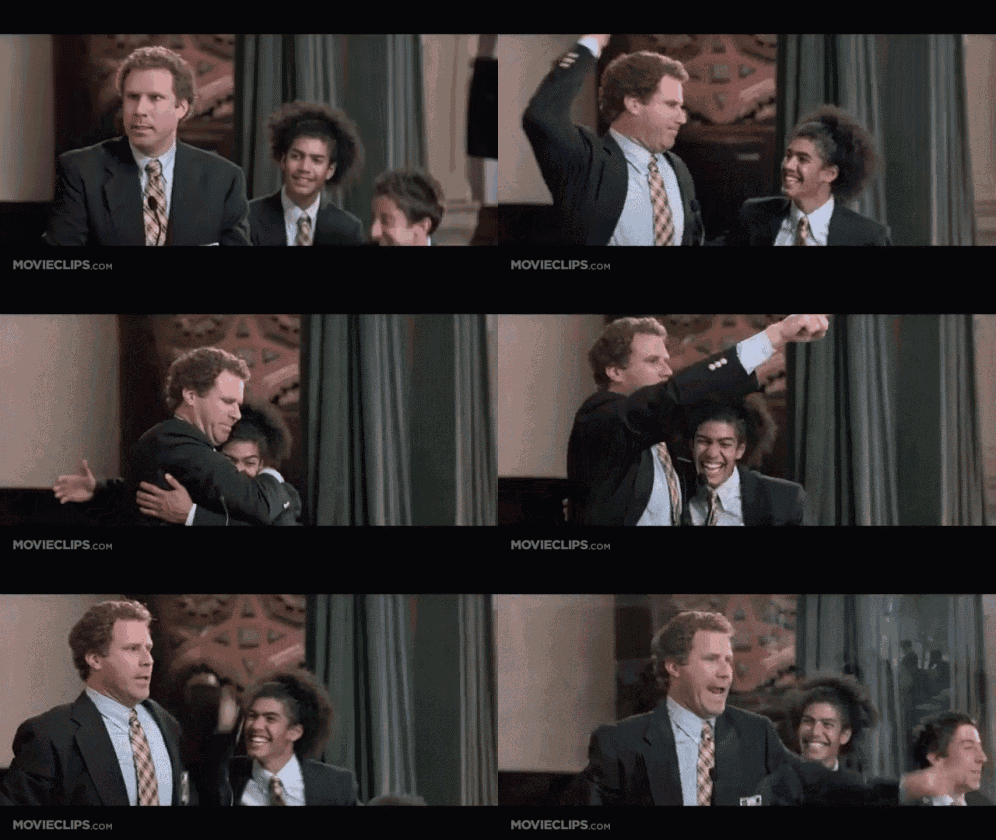
Anyone remember that scene from Old School where Will Ferrell steps up to debate ‘The Ragin’ Cajun”, James Carville?

Curious enough, something similar happens to me from time to time.  Some people say that I’m articulate and well spoken but I may just be well rehearsed.  When I’m discussing something that I’ve given a lot of thought to, I’ve already had those conversations numerous times in my own head.  Perhaps that’s why my mind wanders when I’m giving speeches.  Perhaps even more curious, it’s often this state of mind which tends earn me that ‘mic drop’ moment.

Anyways, I had one of those moments in the shower earlier and I thought it might be worth writing down.  The debate question is:

What’s the real issue in American politics today?

Going into blackout mode…


This isn’t a black versus white thing, this isn’t a rich versus poor thing, and this isn’t a left versus right thing. This is what happens when politics becomes more important than governance.  This is what happens when a duopoly of power prioritizes the short-term success of their party over the greater good of the people they’re supposed to serve.

The American people have democracy, but in a democracy where you’re asked to elect someone you don’t know to run a system you don’t understand, what exactly are you asking of your people?  In an election process that requires billion dollar campaigns, who do you expect to be influencing those candidates?  In a system with such obvious fundamental flaws,  why do we keep expecting different outcomes?

When we start to notice what’s happening though, rather that acknowledge our mistakes and work to solve our problems, we’re given someone to blame.  If you’re rich, blame the tax raising democrats.  If you’re poor, blame the heartless republicans.  If you’re middle America, blame the coastal elites.  If you’ve lost your job, blame the immigrants.  If you’re a liberal millennial, blame the white man.  It’s all utterly ridiculous because when someone understands how interconnected we all are, it’s very easy to see that we’re all in this together.

The American people want freedom.  That’s the freedom to be whoever we want to be and love whoever we want to love.  That’s also the freedom for businesses to compete without unnecessary regulations.  The American people want lower taxes, but don’t mind paying them as long as they’re spent well.  The American people want someone working 40 hours a week to earn a livable wage.  The American people want to stop invading other countries.  The American people want affordable access to health care.  The American people agree on almost all major issues, but through the spin cycle of politics and media, everyone’s divided without even really understanding why.

The universe always finds it’s equilibrium.  Just after Trump was elected, I said this may be a good thing.  Not because he’ll be any good at his job, but because he might just be catastrophically bad at it.  Just maybe he’ll lie more than any politician ever has.  Maybe he’ll flip flop all of his policies.  Maybe he’l have temper tantrums so frequently that people question if he’s mentally fit enough for office.  Maybe he’ll let his racist undertones influence policy.  Maybe all the shady stuff that he’s done in the past will come to boil over during his presidency and we can finally have a complete meltdown of the confidence in our government.

Maybe that’s when we stop paying attention to them, and start paying attention to each other.  Maybe that’s when we start to drive our own rhetoric around the values that got us here in the first place.  Maybe that’s when we’ll finally open our minds to what government could be.


Honest Modesty

There’s a fantastic quote from Bruce Lee, “If I tell you I am good, probably you will say I am boasting.  But if I tell you I’m not good, you’ll know I’m lying.”

By most people’s standards, Bruce Lee wasn’t just good, he was one of the best to ever do what he did.  But if he were to say that, then he risks being labelled as boastful.  Why?

The Rick side of me wants to say that those with insecurities about their own abilities would prefer that high achievers understate their skills and accomplishments to minimize feelings of inadequacy and inferiority.  They key word there being feel.

The more patient side of me thinks there’s another level to this.  Honesty is communication in it’s most accurate form.  When you’re being honest with others, you’re giving them the most accurate version of the information you have.  When you’re being honest with yourself, you’re looking at the most accurate version of yourself.  As working with accurate information is always more efficient than working with inaccurate information, honesty is key to an efficient life.

I also value modesty.  For me, modesty is a perpetual state of mind in which I remind myself that there’s always more room to grow and that what I’ve accomplished isn’t nearly as important as what I’m working towards.  Google’s definition of modesty is an unassuming or moderate estimation of one’s abilities.  I can work with that.

Unassuming and moderate are worth exploring here.  For me, unassuming means knowing your value, but also leaving your mind open for the things you don’t know.  For example, an unassuming fighter would know the techniques they’re best at, but wouldn’t assume to know how successful they would be against a hypothetical opponent.

In a universe with nearly infinite variables – most of which are unknown to us – any prediction of the future is an assumption.  Being unassuming is simply a more honest and accurate understanding of yourself and the universe you exist within.  Being moderate, in this case, could probably be defined as without bias.  Without a desire to understate or overstate one’s abilities, the middle ground would be a moderate estimation – again, the most honest and accurate understanding.

Perhaps there will always be people who would prefer that high achievers keep their achievements to themselves to minimize feelings of insecurity.  For the rest of us however, I think it’s important to understand that modesty isn’t a function of class, or making others feel better about themselves, it’s a function of honesty and accuracy.

If you’re great, be great, do great.


Analogies: Capitalism

a long time ago, someone designed a car.  It was beautifully engineered and truly revolutionary.  It was so well designed that it was pretty much built to last forever.

While the car was a something for the history books, the drivers were inconsistent.  Some understood the mechanics and drove respectfully.  Some showed less regard for the car and drove as it suited their agenda.

Along the way, drivers began allowing for more passengers.  Some for altruistic reasons, some because they paid, and some for the sake of personal relationships.

The car was built well enough to handle a few extra passengers, but as passengers increased and time wore on, key parts of the car started to wear down.  All the added weight was creating excessive pressure, leading to wear on parts that the car couldn’t function without.

Some of the older passengers are looking out the window saying the car looks just fine.  They can tell that the ride is bumpier but it’s hard to notice in a cushy seat.  They know that car was built to last and they know it’s gotten them this far.

Those who are more familiar see that the car is unsustainable.  If we maintain this rate of passengers, the car will fail.  If we want to reduce the amount of passengers, we can keep the car on the road.

Ironically, we’re so focused on the survival of old reliable, that we haven’t given any thought to the new models.  Technology changes everything.  As great as that car was, modern technology has changed how we get from point A to point B and it’s important to appreciate those changes.  There are ideas which we didn’t have the technology to pull off before but could be more viable today.

It’s dangerous assuming there’s no room for improvement.  Might be a good time to look at some options.  Even better, why don’t we look at what we need from our car, learn from our peers, and build something new and inspiring from the ground up.


Redemption of a Marijuana Addict

Not long ago, I wrote a piece on my addiction to marijuana.  It wasn’t that I couldn’t stop when I wanted to – because I had several times before – it was that I didn’t want to.

I spent the last 4 years of my life managing portfolios for high net-worth individuals at one of the world’s most recognized banks.  I’m no stranger to long hours and high pressure environments – that’s my comfort zone.  This was different though and it took me a while to figure out why.  In a nutshell, the industry is marketed as advice but it’s structured entirely as sales.  Your only performance criteria is bringing in new money, but if you were honest about that with your clients, you wouldn’t have any clients.  Trying to do right by my clients while appeasing management was a daily battle and one which I was losing because I wouldn’t compromise my commitment to my clients.  This was my own personal hell – being completely invested in something that required me to compromise my integrity and my character to achieve success.

By most people’s standards, I don’t really stress out about things.  I’m usually Mr. Cool Calm and Collected but I think part of that is how I manage myself.  The gym is a great outlet – so was smoking a ton of weed.  I never smoked before or at work because of my professional standards, but I smoked just about every night before bed.  I did take a few breaks, including a 6 month break to prove to myself that I could stop when I wanted to – but had decided that I’d rather smoke weed.  It made life more enjoyable.. or maybe more tolerable.

In the last stage of my career at the bank, I moved to join a senior team to insulate me from management and remove my sales targets.  To ensure that I could respond with my best effort, I took another hiatus from weed.  Management wasn’t having any of it and fired me in the first week of January.  The first thing I did after leaving the office was sign up at the local dispensary and  I spent most of the next month stoned.  The following month, I broke my arm.  Rather than take the opiates they prescribed to me, I spent the next couple months stoned *all* of the time.  At my peak, I was smoking an ounce per week.

I smoked so much that it seemed like I had disassociated from everyone else’s reality and only existed within my own.  With a logical mind, a knack for research, and a priority of having the most accurate view of my world – I was able to understand why I had failed so spectacularly.  Global banks are massive corporate entities which operate in heavily regulated environments.  They’re structured for the purpose of stability – maintaining the status quo.  At the very core of my being, it’s in my nature to challenge the status quo.  That was a very important insight that helped me understand that if I was going to achieve the levels of success that I wanted for myself – my maximum utility – I needed to seek out a different environment.

I moved back home and started looking into tech, venture capital, and cannabis.  Tech looked like it would take some time to find the right opportunity but there were opportunities.  Venture capital gave me some very interesting advice.  They said that all the qualities that made me a pain in the ass for the big banks were the same qualities that made me a great leader and an effective CEO for a much smaller company – then they said go be a CEO.  When I looked into cannabis, I went to my favourite dispensary and spoke with the owners about making some introductions.  They said they’d be happy to but then we started getting into their expansion plans.

Last year, they were awarded top dispensary in the city and top dispensary in the country.  It wasn’t hard to understand why, they had the finest herb, a brilliantly designed shop, and a caliber of staff which made the experience far more like a casual wine tasting than buying a drink at a bar.  Their reputation had plenty of people approaching them offering to invest to help them expand and this was all foreign territory for them.  I offered to help in any way I could and they appreciated it.  A couple weeks later, I built a business plan for their expansion.  A week after that, they asked me to lead their capital raise.  A week after that, I introduced them to the top cannabis VC in town and a week after that, we were competing for a slot at the Arcview Investor Forum (think sharktank for week).

When we first discussed the game plan, we were going to start the raise towards the end of the summer.  It was going to give us time to clean up the books, do a legal restructure, roll out some strategic marketing, and refine our vision for what came next.  Unfortunately for us, our deadline for qualifying for the Arcview forum was 45 days.  I told them no problem – long hours and high pressure was my jam and I’d be happy to lead the charge.  They accepted and we were off to the races.

For the few weeks leading up to this, I had a few moments where I told myself that it was time to take another break but smoking weed was way too effective at alleviating my boredom and far too useful in helping me sleep.  When I took this project on however, it was no longer about me.  I had committed myself to something that deserved my best effort, to people who deserved my best effort, and to something which I was legitimately passionate about doing.  I told the founders that they were going to get the best out of me if I was sober and so I was making a commitment that I wouldn’t blaze until we raise.  The founders were a mix of amused, confused, and happy that I was so committed.

Just about every day started at 6am and ended at midnight.  Weekends were irrelevant.  Any time I spent not working on this project was time I spent maintaining the level of balance necessary to get the most out of the hours I was putting in.  My commutes were filled with calls.  My meals out were with key contacts.  My meals in were spent watching material relevant to this project.  I was consumed – and couldn’t be happier.

I’ve never been this engaged.  I’ve never been this excited to be a part of something either.  This is the first time in my life that I’ve been able to apply my mind like this and I feel like I’m in my element.  This is my jam.  The harder I work, the more I want to work at it.  The more we push forward, the more obstacles and barriers seem to dissolve in front of us.  The best part?  The core values behind the business have very little to do with cannabis – it has everything to do with social freedoms.  To borrow a line from Starbucks, ‘we’re in the business of social freedom, we just happen to sell cannabis’.  That’s something I can get behind all day long and I seem to have a bottomless pit of energy and passion for it.

The craziest part? I kinda forgot about weed and I think there’s a super important lesson there.  If I look throughout my life at the times when I was smoking most, there’s a pattern.  They were also the times where I was the least satisfied with my life.  It’s easy to say that I was using it to unwind, or de-stress, but I can’t help but think that those are euphemisms for an escape.  When I was stoned, I was no longer concerned with my daily struggles.  It put my mind elsewhere – sometimes nowhere.  Now that I get to spend my waking hours pouring everything I have and everything I know into a totally worthy cause, being stoned isn’t nearly as appealing.

Before we made our submission, I had some of the city’s top VCs and CEOs review the pitch materials before our submission.  The response was unanimous and tremendously positive.  One of the top investors at Arcview was local and was beyond impressed.  The ‘chief mentor’ at Arcview said that this was so well done that he expected Arcview investors to reach out to us directly in such a high volume that we’d complete the raise before we even reached the forum.  We were pumped.

Last week, we submitted our pitch package to the Arcview Group and while we scored the highest score of any submission that round – we scored just below their cut-off for the investor forum next month.  This was a remarkably frustrating experience.  Those who were supposed to qualify us were supposed to read through our executive summary and team bio, go through our pitch deck, and then watch the pitch video for which we were available for a live Q&A after.  The video was played through GoToMeeting – meaning that it was too choppy to watch.  The questions being asked in the live Q&A made it evident that they hadn’t even looked at the rest of our materials.  It was remarkably frustrating.

That night, I had a friend and his wife over for dinner.  He brought a joint.  I said no at first, but then I rationalized it.  I poured myself into this process and put forward something that I was incredibly proud of.  While it didn’t receive the result I wanted, I still qualified it as a success.  The joint was part stress-relief and part reward for an effort I was genuinely proud of – and I’m happy that I did.

I went from a state of frustration to a state of relaxation.  Without the preoccupation of the day’s failure, I was able to be more present and enjoy the company of my friends.  Colours were brighter, the food was better, and the music was especially good – I felt elevated.

I had been such a heavy user of cannabis for so long that I had burnt out my cannabinoid receptors to the point where no matter how much weed I smoked, it simply brought be back to a baseline of haziness.  I had abused the drug rather than used it.  I can’t stress enough, how important of a lesson that was for me.  For me, this wasn’t a lesson in yes you should or no you shouldn’t, it was a lesson in balance.  I doubt this journey is over, but these last few months have been a remarkable learning experience… and I’m just getting started.


The Wonderful Flaw in Capitalism

So sleep hasn’t come easily to me since I was young, but perhaps it’s both a blessing and a curse.  As I lay awake at night wishing I could fall asleep, my mind continues to problem solve.  A few months ago, I was doing my best to understand the difference between the idea of democracy, and the application of it in American politics – and effectively understand where things went sideways when 20% of the American public was able to elect someone which most of the world despised.  More recently, I’ve been focused on capitalism and more importantly, how it’s led to an unsustainable concentration of wealth.  At about 2am a couple nights ago, I woke up Siri to take a note.  That note reads:

“The fly in capitalism is the assumption that resources are scarce” 

I had said flaw, but close enough, Siri.  What I first tried to do was understand what capitalism is at its core.  My best definition was the exchange of resources for the creation of value.  Whether you’re producing a good, a service, or something in between, capitalism was there to reward you with resources to help you sustain yourself and with the goal of motivating you to create more value in the future.  Theoretically, in capitalism, those who create the most value should be rewarded with the most resources.  I don’t think that’s the case today.

As  the application of capitalism evolved, it became a heavily complex system and as with all systems, they can be taken advantage of.  For example, some businesses specifically target customers who don’t fully understand the transaction and end up paying for services they don’t need or products they can’t use – selling ice to an Eskimo.  While some examples are blatant, I suspect most are shades of grey.  Those shades of grey allow those with a greater understanding of the system to manipulate that transaction of value for resources – ultimately leaving them paying less or receiving more.  In this environment, the most significant factor in deciding who receives the most resources isn’t the ability to create value, but rather the ability to understand and play the game.

When I look across the board of the wealthiest people in the world, I don’t see a direct correlation between the wealth they’ve accumulated and the value they’ve created.  There are some, like Bill Gates, Jeff Bezos, or Larry Paige who I think should be among the wealthiest individuals in the world, but for each of them, there are dozens of wealthy individuals who have made their fortunes by extracting resources rather than creating value – casino’s come to mind.

So when I understood that, I thought that we just needed to find a way to get back to the fundamentals of capitalism.  We just needed to find a better way to ensure that there was a fair and equitable approach to the exchange of value for resources.  But wait… if resources weren’t scarce, would capitalism still motivate us to create value?

I know this is all super high level so let’s make this more tangible.  The sun currently projects more energy onto our planet than we’re capable of using – and we’re getting increasingly better at harnessing it.  99.9% of the resources ever used on this planet are still on this planet because as it turns out, matter can’t be destroyed.  That means that resources aren’t scarce, we’re just temporarily inefficient at turning used resources into usable resources.  That’s a technological issue that we’re getting increasingly better at solving – one which I expect to be largely solved within our lifetime.

So let’s be optimistic and think 100 years out.  There are solar panels everywhere.  Roads, roofs, cars, skyscrapers, and huge chunks of desserts are covered in enough solar panels to passive provide our planet with sufficient energy to both sustain and grow.  Waste conversion technologies have advanced to the point where a landfill can be broken down into synthesized raw materials.  Additive manufacturing is able to take synthesized raw materials and efficiently build just about anything that our minds can imagine.  If that ecosystem sounds familiar, it’s because that’s pretty much how our planet worked before humans came along and started trying to reinvent the wheel.  Mind you the earth did it at a much slower pace, but the fundamentals are the same.

Waste is a concept only known to humans.  In every other aspect of the known universe, it’s simply another state in which energy or matter can exist.  Once we can wrap our heads around that, it’s easier to understand that there is no scarcity in resources, simply an temporary inefficiency in turning used resources into usable resources.  That is something that I’m confident technology can solve, and it has me looking rather optimistically towards the future.

In a future where resources aren’t scarce, what would motivate someone to create value for others?  This is where the crusty capitalists might say that people are inherently lazy and it’s only through the motivation of scarcity that they’re willing to provide any level of value to others.  It’s too easy to find counter-examples for that to be entirely true, but I don’t deny that the fear of not being able to sustain yourself can motivate people to do all kinds of things.  What I also think though, is that love is a far more powerful motivator.  In this case, it would be love for what one does.  More often than not, the best computer programmers, the best musicians, the best entrepreneurs, and the best parents are those who absolutely love what they do.  Between their hardware, firmware and software, they’re totally in line with their life’s work.  They’re in their element.  They love what they do, and as a result, their drive, passion, and work ethic to create value for others far surpasses what they might have done out of fear.

That is the future I see and the future that I’m confident we’re headed towards.  We’re a few years out, and there will be plenty of stumbling blocks between now and then, but this is a logical eventuality which is simultaneously an enlightened perspective on how technology drives progress, and how progress drives ideology.  The future is bright and oh so cool.

The Real Cannabis Conversation

As is often the case, I think the the most interesting conversation on the topic is the one we’re not having right now.   I find that as people argue, they become more interested in defending their perspective than understanding another’s and I think that’s a key issue here.  While there are plenty of conversations around how to legalize or how to criminalize, I think the real question is why we should legalize or why we should criminalize.  When we take a proper look at the why behind whether or not we as a people should have legal access to this drug, we have a great opportunity for self-reflection.

I think the first thing we should do define is the term ‘drug’.  When heroin is found in the streets, it’s discussed as a highly illegal and highly dangerous drug.  When morphine is found in a hospital, its discussed as a pain killer and part of the medical process.  Both are obtained from the Opium poppy.  When you remove all the bias, drugs are simply something you put in your body for a desired effect.  That means they’re a tool and tools are remarkably indifferent to how we use them.

So why do we takes drugs then? I think we do it to adjust our state of mind.  Even drugs with no psychotropic effects are still targeting state of mind in a less direct manner.  Consider using an over-the-counter pain killer for a sprained ankle.  The ankle is an injury of the body, but the pain that’s being addressed is a state of mind.  If the mind was unaware of the body’s pain, the painkillers would be unnecessary.  Even if you’re taking drugs to address an illness with no obvious symptoms, you’re taking the drugs to address the concern of a future illness – still looking to resolve a state of mind.  So what if the issue isn’t a physical illness?  What if it’s mental?  What if it’s social?

There’s  a fantastic Sherlock quote… something along the lines of “I’m not an addict, I’m a user.  I look to alleviate boredom and occasionally stimulate my thought process.”  It’s interesting because if you say that it’s something you use to limit boredom, it’s relatable but if someone says they’re using it as a coping mechanism, it’s a bigger issue.  What if it’s a mechanism used to cope with boredom?  What I’m trying to demonstrate is that we’re really just scratching the surface of what drugs are and why we use them.  All we know is that we put them in our bodies to get us closer to the state of mind that we want to be in.  There’s a tremendous amount of research to do there, and I think the answers we arrive at will speak volumes on the human condition.

So let’s bring this back to cannabis.  Why do I take it?  Primarily for sleep, to escape my thoughts, and to alleviate boredom.  I recognize that the closer my life gets to where I want it to be, the less I want to escape from my reality and the less weed I look to consume.  That’s my personal experiment at the moment, if I’m where I want to be mentally, then will I still look to change my state of mind?

A great question to ask when discussing marijuana is addiction.  Most people would suggest that marijuana isn’t addictive because it lacks certain chemical properties that create a physiological dependency like some other drugs.  While that may be true to an extent, I’d suggest that marijuana can be addictive simply because of it’s effects.  I’ve had weeks where sobriety was the enemy and it was hard not to think I was staring addiction in the face.  That said, if you dropped me off in a location with no access to marijuana, I’d have a few sleepless nights and then carry on.  It’s easy to think of hard drugs when you think addiction but in reality, many addictions exist purely in the mind.  I think that with sufficient research, one may find that a chemical dependency and addiction are two different things, one is one of the body while the other is of the mind.  If that’s the case, marijuana addiction is possible and likely very real.  We owe it to ourselves to be honest about this and bring this element into the conversation

It’s not often that a drug makes the journey from being an illegal psychotropic to a widely prescribed medicine.  If I were to take this all at face value, cannabis is a miracle plant capable of treating all kinds of illnesses.  While I think that’s a possibility, I’m more interested in seeing the research than jumping on the hype train.  I also think that the medical properties of the plant would be discussed less if legalized recreational access was available.  In the current market, most users have acquired a medical license from a lax medical professional to achieve access for recreational use.  I can’t help but think that if wine were illegal, people would also seek medical licenses with claims that wine extends your lifespan, protects against cancers, improves mental health, and benefits the heart.  They may even be right, but it doesn’t change the fact that they were just looking to unwind with some friends at the end of the week.

So what are the actual medical properties of marijuana?  The real answer is we don’t know.  There’s anecdotal evidence of it successfully treating just about everything from cancer to seizures but the reality is we’ve just started the research.  From what I’ve seen, I suspect there are very real medical properties in the plant but I that we need to understand what they are to a much deeper level before we embrace them to this degree.  For example, I can confirm that it’s the most successful sleep aid I’ve ever used but I must also concede that I never wake up refreshed the way I feel when I sleep without it.  From an introspective standpoint, I think what it does very well is it helps you shift into a more copacetic mindset and it’s that mindset which helps you better deal with things like pain, stress, and anxiety.  Beyond that, I’m looking to learn and making no assumptions.

So what about recreational use?  We’re most of the way there and the momentum doesn’t seem to be letting up.  Every once in a while, some old white guy will say something like ‘I don’t see how making these substances legal will improve anyone’s quality of life.’  I understand that mindset, but I also understand why it’s flawed.  The error is in the assumption that marijuana affects all people equally.  Some of us are easier to get along with when we’re stoned while others are simply far more productive individuals.  There are some people who shouldn’t be using cannabis and that’s OK too.  The solution isn’t restricting access to everyone, the solution is to provide access to everyone and letting us collectively explore the pros and cons.  We’ll make some mistakes and lose some good people along the way, but such is the nature of progress.

Someone might say that it poses too much of a risk but to them I would say that fear makes for poor decision making.  Too often the government treats the general population like a parent treats their children but in reality, the general population is representative of a collective intelligence which is often under utilized.  Look at what happened when we legalized alcohol.  Alcohol abuse has ruined lives while alcohol poisoning has take them.  That doesn’t make alcohol bad, it makes alcohol important.  It makes it important to understand why we drink, and what the real impact is.  Marijuana will be no different.  It’s just another substance, which if anything, is a reflection of ourselves.

I can’t help but think that the majority of those who are opposed to the legalization of marijuana either have a political angle, don’t understand the matter, or are simply afraid.  The solution to each is education.  We all need to know more about what this plant is and what it does, but we’re not going to learn what we want to know by leaving it in the labs because there’s more to it than that.  Marijuana should be legal for the reason that every other drug should be legal.  We shouldn’t be cautious around drugs because they’re bad or illegal, we should indifferent around drugs because we understand that the ethical and practical impact has everything to do with that specific drug and that specific person.  The level of research necessary to truly understand those dynamics requires a decentralized approach to research and fortunately for us, there are plenty of volunteers.

So at the end of the day, who do I think should be smoking cannabis?  Anyone who wants to, on the condition that they understand what they’re doing and why.  We know it’s a plant that gets you stoned and we know it has medical properties.  We need to know a lot more than that.  Part of that process is giving us the chance to explore – and that means legalization.  When it’s all said and done, we’ve tried it their way.. with the whole war on drugs thing… now it’s time to embrace freedom.  The freedom for people to choose how to live their lives.  The freedom for people to choose what medicine they use.  The freedom to choose how to deal with boredom and the freedom to experience the negative realities of poor decision making.  It’s all part of the same evolutionary process… this is how we grow.