Duality of Privilege

When you apply the concept duality to privilege, it creates a rather interesting perspective.  Consider example A:

John is the child of a wealthy family.  His grandfather did very well, and John’s parents never had to work.  John grows up knowing that he won’t have to work either.  John’s parents lead a lavish lifestyle and give John is given everything that he asks for.

As a result of his unique circumstances, John has a unique perspective on life.  In that environment, I could see it being extremely challenging to develop qualities like a strong work ethic, perseverance, or the ability to deal with scarcity.  I could also see it being difficult to develop healthy relationships with others for a variety of reasons.  This doesn’t sound like a life of privilege to me.  Consider example B:

Jane is the daughter of two working class immigrants, and is raised in a rough neighborhood.   Jane grows up admiring the work ethic of her parents, knowing how their sacrifices let her grow up in a better place than where they were from.  Jane doesn’t have much growing up, but she appreciates what she has and learns how to work towards the things she wants.

In that environment, Jane was given several obstacles and challenges which John would be unlikely to face.  I’d like to think there are two ways to look at this.  You could say that John is privileged to not have to work for anything.  Or you could also say that Jane is privileged to have learned a great work ethic when she was young.  Perhaps there’s a key difference between these two though, in that Jane earned her work ethic while John didn’t earn his family’s wealth.  While that may be true, neither Jane nor John earned their circumstances – in this case, their family.  Had Jane been born to John’s family,   would she have turned out any differently?  Had John been born into Jane’s circumstances, would he have developed Jane’s work ethic?  Who’s life would you rather be born into?  If you’re like me and picked Jane’s life because it would probably lead to a more balanced, fulfilling, successful, and healthy life, wouldn’t that be the more privileged life?

When you think about our greats, from Muhammad Ali to Connor McGregor, from J Lo to Jay Z, from Abe Lincoln to Narendra Modi, from Indra Nooyi to Oprah Winfrey, from Ben Franklin to Steve Jobs, and from Charles Dickens to JK Rowling, you start to see a pattern of overcoming a more challenging set of circumstances from a young age.  You know who I don’t see?  I don’t see the children of billionaires.  How often do we see the children of wealthy families behaving as inspiring leaders that move the world forward in a positive direction?

I think that inheritance doesn’t exist in a meritocracy but that aside, I genuinely don’t have any issues with someone inheriting a fortune and then settling down and living a comfortable life with their family.  I just know that’s not the best environment for producing good human-beings.  It looks easy, and nice, and better, but it lacks the struggle, and it’s the struggle which defines us.

The most challenging moments of my life directly preceded my most significant moments of personal growth.  If this pattern stays true for others, is adversity not to be embraced as the fuel of progress?  If so, perhaps privilege represents someone who’s arrived at the destination without having made the journey.  If so, perhaps there’s an argument to be made for an empathetic approach to this whole ‘privilege’ thing.  If we’re lucky, it might be contagious.

The Popularization of Victimhood

I grew up in a low income neighborhood where things were probably a little rougher than average.  It was mostly immigrant families who came here with very little, in search of better opportunities.  In neighborhoods like these, opportunities were scarce so you learned to fight for every opportunity and every advantage.  Sometimes that meant finding ways to sneak two lunches at school.  Sometimes it meant stealing part of the lunch from the person who got up to go to the bathroom.  Everyone was always being tested – if you left an opening, you got hit.

Sounds like a rough place, but it wasn’t without ethics.  Those with disabilities were always off limits, and often befriended by most popular kids.  If someone targeted them, they were immediately protected, and often by the toughest kids.  Others were simply known for being too nice to be picked on, and were supported for taking the high road.  The rest of us.. were fair game.

The appeal of victimhood doesn’t resonate with me and recounting through my childhood, I might I understand why.  When you grow up in an environment where just about everyone is starting at a disadvantage, working your ass off to get to the status quo is the status quo.  Drawing attention to our circumstances for the sake of sympathy or outside intervention just isn’t where we choose to put our energy.  Instead, we work hard in school, become productive members of society, and give back to the community so that we can solve this problem for future generations.  Today, our community center has the largest food security program in the city, one of the best basketball programs in the region (NBA Cares just redid our gym), and gets 75% of it’s funding through fundraising – largely from community alumni.  This is how I learned to deal with disadvantage.

The other remarkable thing that happens in this neighborhood is that we produce great people.  We’re not without our bad eggs, but generally speaking, we’re polite, kindhearted and well intentioned.  Even the friendships made there are more like family than friends now.  We were terrible to each other, but only when it didn’t matter.  When it mattered, we would fight tooth and nail for each other.  Perhaps it left me with a different perspective on when things mattered and when they didn’t.

This is why I struggle to relate to what appears to be a developing culture of victims.  Where I might see an opportunity to redeem myself, it’s as if they see an opportunity to draw attention to themselves.  It’s often under the premise of ‘raising awareness’ which seems well-intentioned but it’s a somewhat incomplete strategy on its own.  There’s a wide gap between being aware of something and understanding it.  Fortunately for all of us, awareness generates dialogue and dialogue helps to develop and circulate good ideas which ultimately help us understand what we’re actually dealing with and how to make progress.  The problem though, is that the solution is to popularize redemption.

Redemption isn’t just inspiring, it’s informative.  It says yes, you can get dealt a shitty hand and still come out on top – here’s proof.  It says look at what I just did, take what you can and apply it to your situation.  The better the story, the more viral that information becomes.  Some of the greatest stories in human history are based in redemption, but you can’t have redemption or all that fantastic personal growth that comes with it without adverse circumstances.  I can’t help but think that with the right perspective, adversity can be seen as positive.  It’s when we suffer that we learn the most about ourselves and the universe around us.  Adversity is that fuel that pushes us forward in the most meaningful of ways.  For the record, this is all from personal experience.

The problem with popularizing victimhood is that it’s encouraging the wrong behavior.  It’s like celebrating the loss rather than celebrating the win.  It’s also creating a sense of pessimism where people are spending more time looking for ways in which they’re being harmed than they are looking for ways in which they’re being loved.  And by the time we’ve all identified as a victim of something, what have we accomplished?  Do we still make a conscious effort to sympathize for a victim when everyone’s a victim?  Do we continue to use the word victim, both for someone who was killed in a mass shooting and for someone who was whistled at on the street?  Where I grew up, the word victim was often reserved for a drug overdose or a homicide, the kind of event you couldn’t overcome.  Now it’s a hashtag, part of how we identify, and indicative of social virtue.

Identity politics, where your social status and implied virtue is linked to your level of victimhood.  A racial minority? 1 point.  Female? 1 point.  Gay? 1 point.  Disabled? 1 point.  Straight white male? – 3 points.  I have to admit, there is some irony in how the popularization of victimhood has systematically marginalized straight white males.

As much hate as they get, this isn’t as much of a white guy thing as it is an old people thing.  They want control because they’re afraid of what will happen if they’re not in control.  They’re intolerant because they’re afraid they don’t know how to deal with change.  In a world of uncertainty, they’re afraid and are desperately trying to keep things the same.  In a world of change, we’re quickly taking over.

Let’s focus less on what we don’t have, and more on what we’re going to create.

Escapism

Alcohol consumption has been increasing steadily for the last 10 years.  Cannabis use is at an all-time high.  Opioids have been declared a national emergency.    Entire sub-cultures of youth and young adults are finding fewer and fewer reasons to leave the house.  It’s like we’re all trying to escape from all this… sucking.

Do well in school.  Work hard.  Be nice to others.  Pretty common advice for most of us growing up.  We were supposed to do well in school so that we could learn the skills necessary to earn a good income.  We were to work hard because the more effort we put in, the greater the reward.  We should be nice to others because it’s important that we all get along.

So what happens when you do well in school but struggle to find a job when you graduate?  And what about those who had to take out student loans?  What happens when you realize that you’re not the one being rewarded for your hard work?  And what happens when you start to feel like the world has genuinely given up on getting along with one another?

You escape.

We all hallucinate our own reality and it is by that mechanism that we can choose to exist in a reality where we don’t feel the weight of these issues.  Some escape to a digital reality, some to an altered state, but the objective is still the same – being there is better than being here.

Why not just step your game up and go take what the world owes you?  Just make sure you out-perform your peers and you’ll get that top 1% lifestyle that you’ve always wanted.  And once you get there, you’ll know that you’ve made it and that you’re truly different than the other 99%.  That’s what a younger me would’ve said.  To the victor go the spoils, so just make sure you win.  Modern-day cannibalism at its finest.

The problem with the ‘try harder’ approach is that it only works in a zero-sum scenario.  If a few people put in more effort while everyone else is doing the same as they were, those who are putting in more effort are likely to receive more rewards.  If everyone puts in more effort, relatively speaking, the effort levels all remain the same.  Effectively, if we all try hard, we all stay exactly where we are.

So being a grown-up is nothing like what we were told.  Effort is no longer the difference between being rich and poor.   Jobs are disappearing to automation at an increasing rate.  The cost of living is climbing faster than income.  Debt has replaced savings.  Home ownership and a family are now an irresponsible financial decision for most.  And when we look to our leaders and our policy makers in the hopes of change, we see one of the most embarrassing breakdowns of governance in the modern age.

We can’t seem to get to where we want to go.  The advice we were given did not hold up.  We’re being told it’s because we’re lazy.  We’re being told that we’re the problem.  It just doesn’t make sense…

Depression.

Escape.

But we rise.

Our hope that the human condition will prevail remains in tact.  While you look to divide, we look to connect.  Where you seek control, we seek freedom.  Where you look to horde, we look to share.  Where you look to keep secrets, we look to expose the truth.  While you’ve looked to maintain the status quo, we look to challenge it.  And where you fear the future, we embrace it.

We’re just trying to be patient, waiting for our turn.  We see you trying to drag this out though.  I recommend against it.  It’s not a fight you’ll win.


Solutions that Create More Solutions

I was reading a Harvard Business Review article a while back and it was talking about the dynamic of a self-perpetuating business.  An easy example is the classic ‘customer first’ strategy:

If you always put the customer first, the customer is always happy and if the customer is always happy, then they’ll keep coming back and every once in a while, they’ll come back with a friend.  As more friends become shoppers, the business grows and more locations can be opened to serve more friends.  As more locations are opened and the business scales, it can reinvest in itself, ultimately leading to better customer service.  And the cycle continues.

Good customer service is a solution to the problem of bad customer service, but it’s also a solution that creates more solutions.  There are other solutions that create more problems.  Cost cutting can be an example:

Revenues are down so you look to cut costs  to maintain profitability.  You realize you can fire your top performing employees who are being paid the most, and replace them with new talent who will work for half as much.  Next year’s forecasts are now back in line with corporate targets.  Solution?

Probably not.  Firing your top performing employees is a quick way to decimate your organizational culture and that leads to lower levels of acquisition, retention, and production.  It was a solution in that it was able to achieve reduced costs, but it also created a problem by way of significantly reduced revenues over the long-term.

This isn’t a business concept.  It’s a universal concept.  It persists in the laws of physics as well as in the truths of philosophy, and it’s one which the world desperately needs to understand.

You have the compassionate crowd who actively fight racism with racism, and actively fight against free speech to protect free speech.  It won’t work.

You have the intelligent crowd who spend most of their time picking apart bad solutions, and then defer to whatever benefits them personally, lacking the understanding that this is all a collective effort.  That won’t work either.

I’m still trying to understand why intelligence and compassion are at odds with one another, because they also share a very significant connection:

The most intelligence decision you can make is a compassionate one, and the most compassionate decision you can make is an intelligent one.

This isn’t neutral territory between the left and the right, this is the guiding star that we should all be following.  Compassion is the compass, intelligence is the map.


A Solution to Gun Violence

I like guns.  I appreciate the engineering, they’re fun to shoot, and it’s a skill I enjoy developing.  That said, I’ve only been out shooting a few times and while I wouldn’t turn down an invitation, it’s not big on my list of priorities.  What’s actually higher on my list of priorities is coming up with a long overdue solution to a very current problem: gun violence.

I guess I should start by laying out a few pieces of my framework on this one.  I agree that guns are fun to shoot and that people should have the ability to protect their families.  I also think that guns as they are today cause more problems than solutions and something needs to change.  When both sides are asking for something reasonable, compromise is a lack of imagination.

The first thing that people have to acknowledge is that this has nothing to do with the history of the country or the second amendment.  This is a conversation about how can we keep having fun at the range while protecting ourselves and our families, without putting lethal weapons in the hands of irresponsible people.

Part of how I arrived here is in observing the US’s global nuclear policy.  Effectively, the US focuses on limiting the number of countries with access to nuclear weapons because it’s risky to have that much lethal power available to someone who’s intentions you can’t be certain of.  So they go around the world intervening and restricting nuclear programs – perhaps rightfully so.  Personally, I think there will just about always be something more sensible for a government to invest in than nukes, but I’m also empathetic to the only reason that they give: we want to be able to protect ourselves from a hostile government.


On a global scale, America agrees that people should have limited access to deadly weapons.  On a domestic scale, they disagree.  I’m pointing out the hypocrisy so that we can agree that guns and gun violence aren’t an ‘American thing’ or part of our culture.  The situation that we’re in now is caused by mental illness, bad government, and a lack of innovation.  Mental illness is something that will take a cultural shift, bad government will take a revolution, but innovation is something we can tackle now.

So how do we close the gap?  How do we give everyone what they want?  Easy.

Non-lethal ammo.

Whether you’re at a gun range, or keeping a gun under your bed for home defense, you don’t need to kill your target.  There is literally zero need for a recreational target shooter to need lethal ammunition.  I would go so far as to say that without the risk of death, shooting ranges would be significantly more popular.  Further innovations would lead to a variety of non-lethal munitions, further diversifying the sport.

For home defense, I suspect most people would agree that if they had the choice, would rather incapacitate than kill.  The reality is very few of us, if any, have the wisdom necessary to know when it’s appropriate to take a life.  As we continue to be reminded, most who think they do are wrong.  If we can agree on that, let’s agree that the reason we want guns isn’t so that we can kill each other, or even kill someone who poses a threat to us, it’s about keeping ourselves safe.  We need a non-lethal ammunition that can reliably incapacitate.

The non-lethal options that exist today hasn’t proven viable, so we need to innovate.  I’m not smart enough to know exactly what this product or these products would look like but I do have an idea on how we could get there.  First the government announces an intent to shift from lethal weapons to non-lethal weapons.  Then, allocate $100 million to a venture capital fund and have that fund approach universities across America, looking to invest in companies developing alternative munitions.   This will spur a wave of innovation in the direction of non-lethal munitions and with a little bit of time, we should arrive at a better mouse trap.  Who knows, maybe we’ll end up with a Star Trek-esque stun gun.

The idea is that if we could design a weapon that was easier to use, barely needed to be aimed, and put your home invader into a comatose state until the authorities arrived, why would you want a classic pistol?  It wouldn’t increase your chances of defending yourself, only your chances of harming the other person.  If we can agree that the people who want to keep using lethal ammunition because it increases their chances of being able to hurt people shouldn’t have access to lethal ammunition, I think we’re all on the same page.  If we could get alternative munitions to the point where they were this safe and easy to use, imagine what it would do for everyone’s personal safety.

I know, I know, I forgot something.  Or rather saved it for last.  Hunting.  I’ll admit I didn’t quite have it figured out when I started writing this but a thought occurred to me while I was writing and it might be a good one.  The one recreational scenario where lethal ammunition does make sense is when you’re hunting, especially when you’re hunting for food.  Hunting for sport should probably be non-lethal to begin with so for the moment, let’s focus on hunting for food.  We need the ammunition to be lethal for our target, but preferably, only our target.  It would be nice to not have to worry about shooting other hunters.  If that’s our criteria, we could probably innovate our way out of this one too.  So we need a bullet that can be fired from a standard rifle which upon impact, would kill a… let’s say moose, but if it hit a person, would be non-lethal.  Sounds to me like a miniaturized dart (like from a tranquilizer gun) containing a compound that would kill a moose while leaving a personal unharmed.  Not only would that prevent nearly all hunting accidents, it may also be a more humane way to hunt.

When reasonable people are asking for reasonable things, compromise is a lack of imagination.  People should be able to protect themselves.  Protecting yourself isn’t the same as hurting someone else though.  If you want to protect yourself by hurting others, you need help.  Let’s find a means to protect ourselves without hurting others, and find a way to help others who haven’t yet figured out why hurting others just about always creates more problems than solutions.

Win the Next Presidential Election With This One Weird Trick

I was tempted to throw in the /s but it’s true.  Seriously.

It wasn’t the republican right that elected Trump.  It wasn’t the democratic left that let Hillary down either.  It was the American people who made themselves heard.  Trump was elected as a giant fuck-you to how America governs – justifiably so.

It was a fuck-you to career politicians with fake smiles and fake laughs.

It was a fuck-you to wall street influencing monetary policy.

It was a fuck-you to the oversensitive and irrational alt-left.

It was a fuck-you to partisan politics and the inability of politicians to get anything done.

It was a fuck-you to the wealthy elite.

And perhaps most importantly, it was a fuck you to a lack of honesty and transparency between a government and the people it serves.

Trump may just be the best thing to happen to American politics in generations, in the same way that a bull is great for a china shop.  Bull wrecks china shop, owner realizes nobody buys china anymore and uses the insurance money to open a dispensary.  I think a lot of the people who voted for him already knew this, but if there was any doubt… he’s worse than a career politician, he’s the wealthy elite’s racist grandpa.  One of the first things he did was cozy up to wall street.  He’s just as irrational and oversensitive as the alt-left.  With republican control over the senate and house, he still can’t get anything passed. Bipartisanship is worse than ever.  Finally, and most importantly, Trump has probably solidified himself as the most dishonest politician in American history.  For anybody looking at this objectively, he’s the one you send in to undermine any remaining confidence in the American establishment.

So by the time the American people are ready to elect their next president, what are they going to be looking for?  The same thing we’ve always wanted…


Honesty and Transparency.


Seriously.  That’s it.  We’re just going to want it that much more after all this nonsense.  Run a campaign under the premise of releasing every confidential government file ever held.  Moon landing?  Release it all.  JFK?  Release it all.  9/11?  Release it all.  Area 51?  Release it all.  Every god damn piece of information that the government has – make it readily available to the public.  Maybe it all amounts to very little, but at least the public would regain their confidence in their government.  Or maybe we find out that the government hasn’t been as honest with us as we would’ve liked and we have an opportunity to rebuild that trust with a proper foundation.

Electing someone we don’t know to run a system we don’t understand isn’t exactly the best example of democracy but it does remind us how important honesty and transparency is between a government and its people.  Without good information, we can’t make good decisions and if we aren’t equipped with the information necessary to elect good leaders, where exactly does that leave us?  And yet honesty seems more scarce in politics than in any other profession.  Maybe this is what happens to lawyers when they don’t have to worry about perjury anymore.

We need to move beyond this idea that being uninformed makes us safer.  We need to move beyond this notion of the government taking measures to make us ‘feel’ safer at the expense of being less informed.  We need the government to stop treating us like kids and start treating us like equals and that starts with telling us WTF is actually going on.

I’m putting some brain power towards figuring out how to build an honest democracy that just doesn’t just hold itself accountable to the public, but also engages the collective thoughts and wisdom of its people on a regular basis.  I’m making progress.. might be ready in time for Mars.


Let me try something..

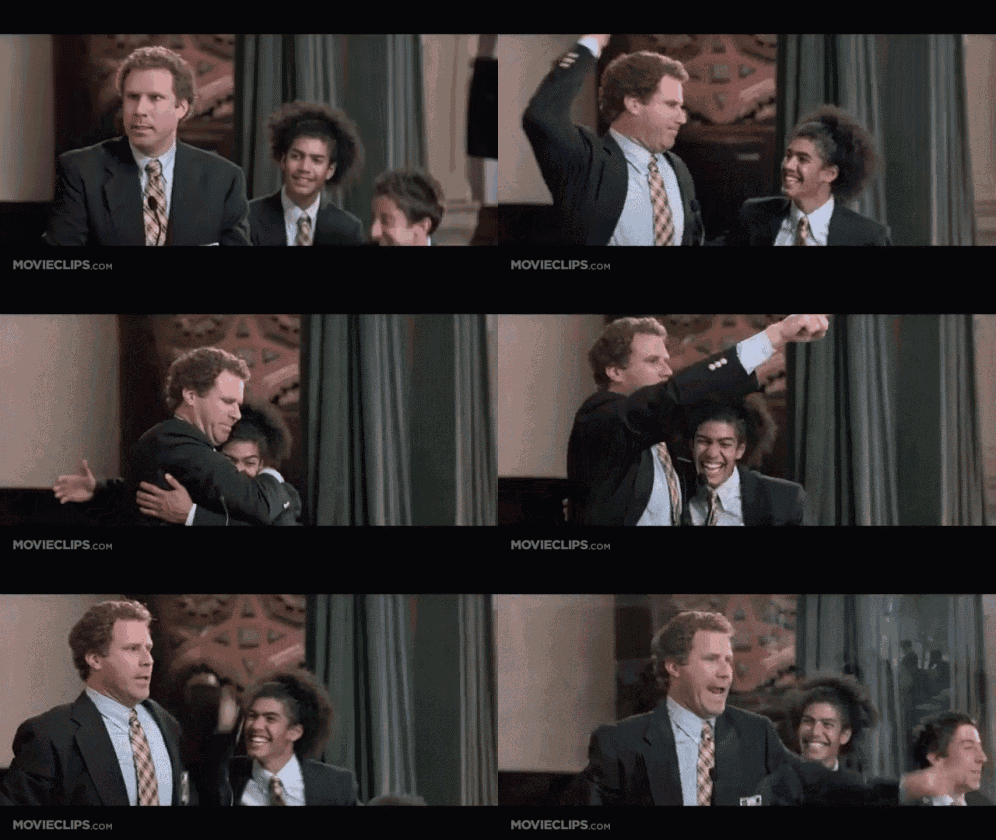
Anyone remember that scene from Old School where Will Ferrell steps up to debate ‘The Ragin’ Cajun”, James Carville?

Curious enough, something similar happens to me from time to time.  Some people say that I’m articulate and well spoken but I may just be well rehearsed.  When I’m discussing something that I’ve given a lot of thought to, I’ve already had those conversations numerous times in my own head.  Perhaps that’s why my mind wanders when I’m giving speeches.  Perhaps even more curious, it’s often this state of mind which tends earn me that ‘mic drop’ moment.

Anyways, I had one of those moments in the shower earlier and I thought it might be worth writing down.  The debate question is:

What’s the real issue in American politics today?

Going into blackout mode…


This isn’t a black versus white thing, this isn’t a rich versus poor thing, and this isn’t a left versus right thing. This is what happens when politics becomes more important than governance.  This is what happens when a duopoly of power prioritizes the short-term success of their party over the greater good of the people they’re supposed to serve.

The American people have democracy, but in a democracy where you’re asked to elect someone you don’t know to run a system you don’t understand, what exactly are you asking of your people?  In an election process that requires billion dollar campaigns, who do you expect to be influencing those candidates?  In a system with such obvious fundamental flaws,  why do we keep expecting different outcomes?

When we start to notice what’s happening though, rather that acknowledge our mistakes and work to solve our problems, we’re given someone to blame.  If you’re rich, blame the tax raising democrats.  If you’re poor, blame the heartless republicans.  If you’re middle America, blame the coastal elites.  If you’ve lost your job, blame the immigrants.  If you’re a liberal millennial, blame the white man.  It’s all utterly ridiculous because when someone understands how interconnected we all are, it’s very easy to see that we’re all in this together.

The American people want freedom.  That’s the freedom to be whoever we want to be and love whoever we want to love.  That’s also the freedom for businesses to compete without unnecessary regulations.  The American people want lower taxes, but don’t mind paying them as long as they’re spent well.  The American people want someone working 40 hours a week to earn a livable wage.  The American people want to stop invading other countries.  The American people want affordable access to health care.  The American people agree on almost all major issues, but through the spin cycle of politics and media, everyone’s divided without even really understanding why.

The universe always finds it’s equilibrium.  Just after Trump was elected, I said this may be a good thing.  Not because he’ll be any good at his job, but because he might just be catastrophically bad at it.  Just maybe he’ll lie more than any politician ever has.  Maybe he’ll flip flop all of his policies.  Maybe he’l have temper tantrums so frequently that people question if he’s mentally fit enough for office.  Maybe he’ll let his racist undertones influence policy.  Maybe all the shady stuff that he’s done in the past will come to boil over during his presidency and we can finally have a complete meltdown of the confidence in our government.

Maybe that’s when we stop paying attention to them, and start paying attention to each other.  Maybe that’s when we start to drive our own rhetoric around the values that got us here in the first place.  Maybe that’s when we’ll finally open our minds to what government could be.


Honest Modesty

There’s a fantastic quote from Bruce Lee, “If I tell you I am good, probably you will say I am boasting.  But if I tell you I’m not good, you’ll know I’m lying.”

By most people’s standards, Bruce Lee wasn’t just good, he was one of the best to ever do what he did.  But if he were to say that, then he risks being labelled as boastful.  Why?

The Rick side of me wants to say that those with insecurities about their own abilities would prefer that high achievers understate their skills and accomplishments to minimize feelings of inadequacy and inferiority.  They key word there being feel.

The more patient side of me thinks there’s another level to this.  Honesty is communication in it’s most accurate form.  When you’re being honest with others, you’re giving them the most accurate version of the information you have.  When you’re being honest with yourself, you’re looking at the most accurate version of yourself.  As working with accurate information is always more efficient than working with inaccurate information, honesty is key to an efficient life.

I also value modesty.  For me, modesty is a perpetual state of mind in which I remind myself that there’s always more room to grow and that what I’ve accomplished isn’t nearly as important as what I’m working towards.  Google’s definition of modesty is an unassuming or moderate estimation of one’s abilities.  I can work with that.

Unassuming and moderate are worth exploring here.  For me, unassuming means knowing your value, but also leaving your mind open for the things you don’t know.  For example, an unassuming fighter would know the techniques they’re best at, but wouldn’t assume to know how successful they would be against a hypothetical opponent.

In a universe with nearly infinite variables – most of which are unknown to us – any prediction of the future is an assumption.  Being unassuming is simply a more honest and accurate understanding of yourself and the universe you exist within.  Being moderate, in this case, could probably be defined as without bias.  Without a desire to understate or overstate one’s abilities, the middle ground would be a moderate estimation – again, the most honest and accurate understanding.

Perhaps there will always be people who would prefer that high achievers keep their achievements to themselves to minimize feelings of insecurity.  For the rest of us however, I think it’s important to understand that modesty isn’t a function of class, or making others feel better about themselves, it’s a function of honesty and accuracy.

If you’re great, be great, do great.


Thought Vs. Emotion

I think that by most people’s standards, I’ve had a challenging life.  I also think that by most people’s standards, I brought most of it on myself – and I would agree.  I have a long history of taking things that should be easy, and finding ways of making them hard.  I’m not actually sure why I have this quality, but I am starting to understand the impact it has on my life.

Each time I put myself in a challenging situation, I had to figure it out.  It wasn’t that I lacked a support system, it’s just that my support system would usually suggest that if I got myself into it, I can get myself out of it.  Over the years, I developed a system that was effectively: Understand where you’re at, understand where you want to be, and find a way to close the gap.  I think the key word there is understand.  It was an exercise in problem solving in the arena of thought.

My father passed away in my mid-20s.  He and I were close – he meant a lot to me.  It was cancer and he lasted about 2 years between diagnosis and death.  Towards the end, I remember having a conversation with a friend about how it would impact me.  I had noticed a pattern over the years which suggested that each time I went through something like this, I became a less emotional person.  Despite all the other challenges I had overcome, I knew that losing my dad would impact me more than anything I had ever been through and I was concerned about how it would impact my emotional disposition – would I have any left?

In the month that my dad died, the first girl I thought I’d marry left me for her ex-boyfriend, I tore my shoulder, and the promotion which I had just moved cities for was rescinded.  After I wrapped up the responsibilities around my father’s estate, I decided it was important to give myself time to grieve to prevent any future imbalance.  The following week was a combination of work, family sized lasagnas, weed, and a few movies that legitimately made me bawl my eyes out (the dad scene in Warrior got me good).  By the end of that week, I figured that the best thing I could do for my father, for myself, and for those who counted on me was to rise above and move forward.  I accepted that my father may have died earlier than I would’ve liked, but I also recognized that he led the kind of life that most people would aspire to.  He had a family who loved him, he was a master of his craft, he built and sold a business, he was respected within his community, and he was the giant upon whose shoulders I would stand on.  I had to wrap my head around that death was part of the natural order in which we all existed, and that I should be proud of the life that my father lived.  I don’t know if it was easy or hard, but I did.

I spent the next 6 months identifying where I was in my life, where I wanted to be, and worked on closing the gap.  By the end of that year, I was headed back home for a new career in wealth management for one of the world’s top global banks.  The loss of my father was never a source of depression for me, instead, I chose to use his memory as a source of inspiration and drive.  Even to this day, everything that I do is in some way for him.

I was often complimented on how well I handled the passing of my father.  I was called very well adjusted.  However, my concerns about becoming a less emotional person seemed to be valid.  The girls I dated since likely saw the same thing.  One said that I was driven, but not passionate.  Another said that I was empty inside.  My favorite though, and perhaps the girl who understood me best, called me her benevolent robot king.  I was a high functioning human being in most respects, but I did it without what most people would call emotion.  I don’t have the wisdom necessary to make any conclusions, but I’m starting to think that there some validity to operating without emotion.

This is where I think it’s important to define the term emotion.  Google’s definition suggests that emotion is a natural instinctive state of mind deriving from one’s circumstances, mood and relationships with others.  For me, the key word is instinctive and I think there’s a key difference between instinct and thought.  I’m sitting here trying to think of exactly what that is and I don’t think I can define it just yet.  When I try, I think of instinct like firmware and thought like software.  The firmware came with the hardware and can be tough to update.  Software however can be updated often depending on the applications you want to run and the tasks you’re looking to accomplish.

Before modern cognition, instincts were paramount to survival.  In modern society, our instinctual drives often seem counter-productive.  Easy examples include men cheating on their spouses because of their instinctual drive to procreate with multiple partners or women searching for men with the physique and resources to protect and provide for them.  If we were to understand these types of behaviors as instinctual and left over evolutionary characteristics from a past era, I think we’d understand each other a little better.  Unfortunately, this is where ’emotions and feelings’ come into play.

In many of my relationships, I was told that I had to respect their emotions or respect their feelings.  I understood that I should respect the person and that their emotional state is part of who they are, but I didn’t understand why I should inherently respect their emotions.  Perhaps my favorite example is when a girlfriend spent the day angry at me because I had cheated on her in a dream – for the record, I’ve never cheated.  I understood and appreciated that she had sensory input that triggered instinctual fears of losing a mate but what I didn’t understand is why it was acceptable for her to ‘feel’ upset with me let alone why that state of mind should be respected.

The more rational I became, the more challenging I was for someone who was emotional.  I was still nice, I still wanted to be a good person and I was still working hard to make a positive impact in the world, but thought and emotion were often two different perspectives in the world and one often struggled to understand the other.  What I’m going to say next might ruffle some feathers, and I could be wrong, but it’s my current evolution of thought on the matter.  I think that thought is a higher form of cognition than emotion.  I’m not prepared to say that one is better than the other, or that one leads to a happier life, but I am prepared to say that on average, thinking things through is a more successful approach than feeling things out.

When I think of humanity’s greatest thinkers and what they’ve accomplished, I’m inspired.  When I think of humanity’s greatest feelers and what they’ve accomplished, I draw a blank.  When I think of humanity’s worst, I think of people who let hate and prejudice get the better of them.  Hate is an emotional state while prejudice is a lack of thought.  However, I cannot accurate say that all good things come from thought while all bad things come from emotion because without emotion, where’s the love?

This would surprise many, but as rational and robotic as I am, I still cry on a regular basis.  I’d say about once a month, I see something beautiful or something sad that touches me and gets me misty eyed at the very least.  It was the kind of thing that I would fight when I was younger but I embrace now.  Fear doesn’t really register with me the way that it does with other people, but I do have a very real concern about losing that connection because there is something that feels very human about it.  Something that I respect and appreciate about emotion is that the best moments in my life were emotional.  Happiness is an emotional state of mind.

Where I’ll leave this for today is a theory that I’m working on.  We only have one body, we only have one central nervous system, and we only have one brain.  On that basis, emotion and thought have to be connected.  Emotion seems to have a stronger connection to the body and the subconscious while thought seems to have a stronger connection to the outside world.  I think that in earlier stages of evolution, instinctual drives and internal monitors were more closely associated with survival but as we’ve created the world we live in today, it’s become increasingly important to understand the outside world.  Trying to understand the outside world with an instinctual or emotional perspective can be limiting so thought has become more important.  As the outside world progresses, we continue to develop physical and intellectual tools to help understand what’s happening internally.  Currently, I’m trying to understand what will happen to emotion if we continue along this path.  I don’t think that the emotional state will disappear completely, but I do think that it’s importance will diminish as our understanding of how it fits into general cognition evolves.  How Vulcan…


Before Comey Takes the Stand..

I’ve been relatively quiet on the Trump matter since I started this blog.  It’s not because I haven’t been paying attention.  On the contrary, I’ve been studying Trump’s rise and time in the office more intensely than I’ve studied anything in my adult life.  The rise of Trump to power will likely go down as one of the most fascinating moments in our young human history.

I’ve done my best to track articles, ‘news’, and commentary from both sides, as well as engaging with some of the most intelligent people I could find representing the full spectrum.  I’ve already put my money where my mouth is by pushing my portfolio to cash, but I also wanted to document my position here before it looks like I did it through hindsight.

I’m not a fan of facts.  Not because they can’t be true by definition, but because they’re only brief glimpses into a greater truth which, without context, can obscure perception.  It’s much like watching brief clips of a movie without being able to see the movie.  It’s true that each clip was part of the movie, but seeing them out of context doesn’t lend to understanding the true nature of the film.  For me, I search for patterns.  Patterns tend to repeat themselves and are therefore much more enduring when it comes to understanding the greater truth.

Trump’s not a good person.  He’s not a very smart person either.  He’s likely guilty, but he wasn’t smart enough to put this together.  In all likelihood, he’s being used – the extent of which he probably doesn’t realize.  I doubt that it’s a single entity or a grand collusion behind Trump, I think it’s more likely that it’s been a patch-worked collaborative effort by several groups who realized they could push their agenda through Trump.

This is a game in which Trump is a pawn who doesn’t realize he’s a pawn.  Ironically, several other players on the board, like the Russians and The Koch brothers think they’re pulling the strings, but even they’re pawns in a much larger game.  This is a game of love versus fear.